Welcome back for the second post of my blog! Last week, I talked about what dramaturgy is and introduced you to the concept of omniturgy. This week, I'm taking my dramaturg's curiosity and applying it to one of the major queries of our time: What is a geek?
I've discussed this issue with my friends and loved ones (and the occasional random acquaintance) for years now, and the conversation generally gets hung up on the following debate: geeks vs. nerds vs. dorks.
The distinctions my social circle has agreed upon in the past are as follows:
So what is a geek, really?
According to the Oxford English Dictionary, the earliest use of the term appeared in 1897. It referred to an uncultivated or foolish person, and for a time, it was used as a racist term for barbaric jungle dwellers and cannibals (many "freak shows" featured geeks who bit the heads off live animals - ew). By the mid-1950s, "geek" had shed its racial (and cannibalistic) connotations and exchanged them for ties to extreme academic diligence; this is one of the word's common usages today, and it is used more or less interchangeably with "nerd." In the 1980s, the term became more specialized. A geek was no longer just an overly diligent, unsociable student; "geek" began to refer to people whose devotion and expertise focused on computers and related technology (hence, "computer geek").
This is the end of the OED's entry, but not, I think, the end of "geek"s story. Like all the best words, "geek" has multiple meanings and varying levels of specificity. We've already discovered that "geek" can mean the same thing as "nerd" - an enthusiastic intellectual who may or may not focus on a specific pursuit (like etymology, for instance). It can also refer to those nerds whose specific focus is on science/technology. But what of geek culture? What about the Trekkies, and the residents of the Whoniverse, and those who worship at the altar of Joss Whedon (the man is a genius!)? What about the gamers and the anime enthusiasts? What about every single person who goes to Comic-Con? They're all geeks too, aren't they?
It appears that the definition of geek has re-expanded to include lots of misfits, not just those who speak C++. Wikipedia* gives an expansive definition: "a slang term for odd or non-mainstream people, with different connotations ranging from ' a computer expert or enthusiast' to 'a person heavily interested in a hobby'" - hence history geeks, archaeology geeks, TV geeks, music geeks, crafting geeks, sports geeks (I swear it's a thing!), band geeks, theatre geeks, etc. The article also notes that the term has been reclaimed in the past decade or so and divorced from its derogatory associations - especially those referring to poor social skills. We have united, we have bonded, we have cross-bred, and now geek culture is on the rise, and it's everywhere.
Check out your TV if you're looking for proof: The Big Bang Theory is one of the most popular sitcoms on network TV, any number of shows have parodied the Star Wars trilogy (this one is my favorite), and there's an entire channel dedicated to science fiction and fantasy programming (the stupidly-spelled SyFy channel) included in most basic cable packages. And look at clothes - the Men's department at Target features dozens of tee shirts with geeky inside jokes featuring references to sci fi, gaming systems, and internet memes (it's somewhat less common in mainstream women's fashions, but it still isn't too hard to find - I know I wear my Blue Sun shirt with pride). And speaking of the internet - try Googling the word "geek" sometime. Seriously, just try it.
So who's a geek? We already know dramaturgs fall under that category. But if you've ever wasted time looking up arcane details about one of your hobbies, or if you make sure to check your favorite webcomic every week, or if you've ever laughed at a lolcat, there's a chance you might be too.
That's it for this week's entry. If you think you might be an omniturgy geek (or if you think you might someday want to be one), subscribe to the blog to get reminders for the weekly posts. And before you go, leave a comment about what you like to geek out about!
* Using Wikipedia as a research source is a twitchy business since it's a wiki platform, which means that anyone can add information, regardless of whether it's correct. Wikipedia does make an attempt to ensure the accuracy of its entries, but it wouldn't fly as a reputable source for academic research. In the case of pop culture and public opinion, though, I think it's reliable enough.
Additional Information:
XKCD (one of my favorite webcomics)
The Oxford English Dictionary (absolutely the last word in Scrabble debates - but you need a subscription through a school or library)
Wikipedia article on Geeks
I've discussed this issue with my friends and loved ones (and the occasional random acquaintance) for years now, and the conversation generally gets hung up on the following debate: geeks vs. nerds vs. dorks.
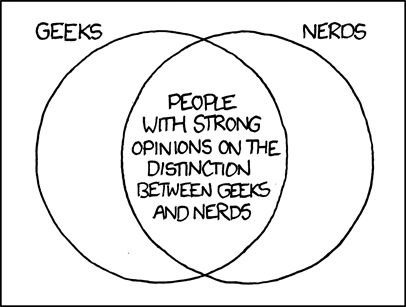 |
| The truth of the matter |
Nerd - Interested in and knowledgeable about a variety of subjects, has social skills (think Topanga from Boy Meets World)
Geek - Interested in and knowledgeable about a few specific subjects, has limited / no social skills (think Urkel from Family Matters)
Dork - Enthusiastic about everything, not especially knowledgeable, no social skills (think Screech from Saved by the Bell)But is this accurate? By these definitions, the nerds from Revenge of the Nerds (yay for a pre-ER Anthony Edwards!) are actually geeks. And what about the men of The Big Bang Theory? Are they all geeks? Are any of them? I, myself, formerly identified as a nerd but now often call myself a geek (even though I do - I hope - have perfectly adequate social skills). Clearly, there's something amiss with the above definitions.
So what is a geek, really?
According to the Oxford English Dictionary, the earliest use of the term appeared in 1897. It referred to an uncultivated or foolish person, and for a time, it was used as a racist term for barbaric jungle dwellers and cannibals (many "freak shows" featured geeks who bit the heads off live animals - ew). By the mid-1950s, "geek" had shed its racial (and cannibalistic) connotations and exchanged them for ties to extreme academic diligence; this is one of the word's common usages today, and it is used more or less interchangeably with "nerd." In the 1980s, the term became more specialized. A geek was no longer just an overly diligent, unsociable student; "geek" began to refer to people whose devotion and expertise focused on computers and related technology (hence, "computer geek").
This is the end of the OED's entry, but not, I think, the end of "geek"s story. Like all the best words, "geek" has multiple meanings and varying levels of specificity. We've already discovered that "geek" can mean the same thing as "nerd" - an enthusiastic intellectual who may or may not focus on a specific pursuit (like etymology, for instance). It can also refer to those nerds whose specific focus is on science/technology. But what of geek culture? What about the Trekkies, and the residents of the Whoniverse, and those who worship at the altar of Joss Whedon (the man is a genius!)? What about the gamers and the anime enthusiasts? What about every single person who goes to Comic-Con? They're all geeks too, aren't they?
 |
| Don't look now, but I think there's one behind you... |
Check out your TV if you're looking for proof: The Big Bang Theory is one of the most popular sitcoms on network TV, any number of shows have parodied the Star Wars trilogy (this one is my favorite), and there's an entire channel dedicated to science fiction and fantasy programming (the stupidly-spelled SyFy channel) included in most basic cable packages. And look at clothes - the Men's department at Target features dozens of tee shirts with geeky inside jokes featuring references to sci fi, gaming systems, and internet memes (it's somewhat less common in mainstream women's fashions, but it still isn't too hard to find - I know I wear my Blue Sun shirt with pride). And speaking of the internet - try Googling the word "geek" sometime. Seriously, just try it.
So who's a geek? We already know dramaturgs fall under that category. But if you've ever wasted time looking up arcane details about one of your hobbies, or if you make sure to check your favorite webcomic every week, or if you've ever laughed at a lolcat, there's a chance you might be too.
That's it for this week's entry. If you think you might be an omniturgy geek (or if you think you might someday want to be one), subscribe to the blog to get reminders for the weekly posts. And before you go, leave a comment about what you like to geek out about!
* Using Wikipedia as a research source is a twitchy business since it's a wiki platform, which means that anyone can add information, regardless of whether it's correct. Wikipedia does make an attempt to ensure the accuracy of its entries, but it wouldn't fly as a reputable source for academic research. In the case of pop culture and public opinion, though, I think it's reliable enough.
Additional Information:
XKCD (one of my favorite webcomics)
The Oxford English Dictionary (absolutely the last word in Scrabble debates - but you need a subscription through a school or library)
Wikipedia article on Geeks

No comments:
Post a Comment